- Home
- Classes
- Astro 1 Spring 2024
- INT 86TN Planetary Defense – Spring 2024
- Symmetry & Aesthetics in Contemporary Physics
- Physics 134 – Observational Astrophysics – Fall 2026
- Physics 150 – Nuclear Weapons and Planetary Defense – Physics, Policy, Proliferation, Solutions – Fall 2026
- Physics 128 – Senior Lab – Winter 2026
- INT 184 – PL Interdisciplinary Honors Seminar – Weapons of Mass Destruction – Spring 2013
- Physics 150 – Modern Design and Fab – Fall 2019
- Physics 4 – Winter 2023
- Physics 141 – Optics – Spring 2019
- Physics 145L – Astrophysics Research
- Physics 199 – Independent Research
- Projects
- Interdisciplinary Center for Interstellar Exploration (iC)
- NASA Watts on the Moon
- Extrasolar Travelers
- CMB-S4 – Ground Based CMB Cosmology Program
- Wafer Scale Spacecraft
- PI-Multimodal Planetary Defense
- Digitized CNEOS Light Curves
- 20m diameter
- 30m diameter
- 35m diameter
- 40m diameter
- 50m diameter
- 60m diameter
- 70m diameter
- 80m diameter
- 90m diameter
- 100m diameter
- 200m diameter
- 350m diameter (Apophis)
- 500m diameter (Bennu)
- 800m diameter (PDC 2023)
- 1km diameter
- 2023 NT1
- Hypervelocity Penetrator Simulations
- Lunar Rover Project
- DE-STAR
- Starlight
- GreenPol – CMB Cosmology
- PLANCK
- Starshot
- SETI
- Small Projects
- Previous Projects
- Facilities
- People
- Net
- Outreach
- Media Links
- NASA Space Grant Student Scholarships
- Bright Stars – VoH
- ARC – Undergraduate Aerospace Research Coop
- POINT – Undergraduate Physics Organization for Innovation and Technology
- All Sky Camera Project
- Education and Public Outreach
- Gaucho Rocket Project
- Undergrad Research Opportunities
- The Space Race
- Misc
- Papers
PLANCK
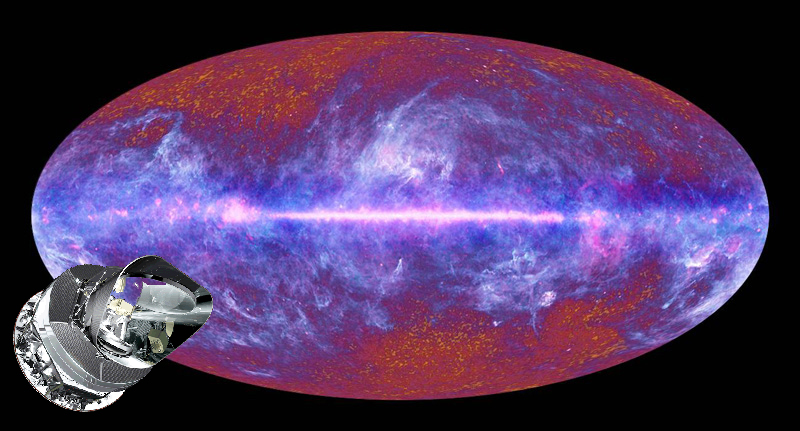
Planck is an international mission led by ESA , the European Space Agency, with significant contribution by NASA, the United States’ National Aeronautics and Space Administration. Launched on May 14th 2009, Planck has mapped the Cosmic Microwave Background (CMB) radiation of the universe with the greatest precision and detail of any all-sky microwave survey to date, across nine frequency bands .
Planck is the fourth generation of satellites to successfully map the CMB, coming after the COBE and WMAP and the Russian Relikt satellites.
The PLANCK mission looks back at the very dawn of time to measure the the Cosmic Microwave Radiation of the Universe, the oldest light we can see, coming from a time when the Universe was somewhere between 350,000 and 400,000 years old – about 13.7 billion years ago.

The minute temperature differences across the sky, on the order of a few millionths of a degree, that have been measured by Planck correspond to density variations in the earliest moments of the Universe. Thus, accurately measuring the cosmic microwave background radiation can give us information about the very young Universe.
Click HERE for a convenient summary page of results and links.
Click HERE for a new CMB Simulator by Stuart Lowe, Planck Scientist from the UK.
Click HERE for a very preliminary look & listen to our Sounds of the CMB page.
NOTE: You must use Google Chrome to access this application.

On 21st March 2013 Planck released the first set of cosmological results. Click on the following link to see the data release conference we held at UCSB:
For more information about the Planck Mission, please visit:
The NASA PLANCK Page at the Jet Propulsion Laboratory in Pasadena, California
Planck Education & Outreach
Planck Main E/PO Website